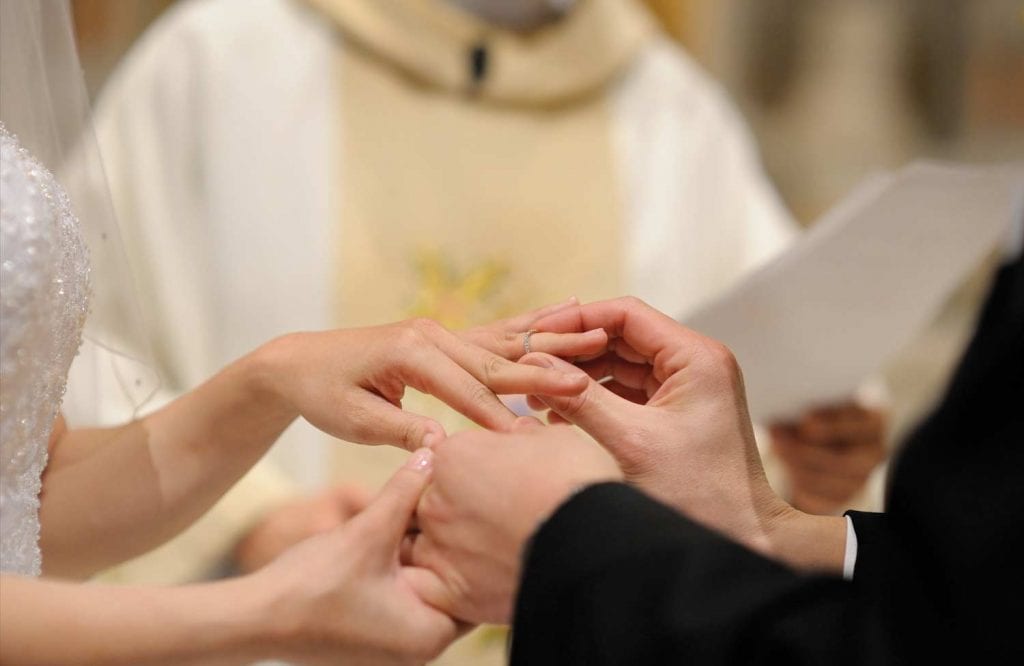
Catholic Wedding Vows For Bride and Groom: Traditional Catholic Church wedding ceremony is a bit different from any other religious wedding. Whether you were reared in Catholicism or converted to the religion for your partner, you know that marriage is one of the most important events in the life of a Catholic and one of the seven sacraments of the Church. As such, Catholic wedding vows are part of a larger liturgy officiated by an ordained priest or deacon within a traditional wedding ceremony.
Catholic wedding vows are an important part of a Catholic wedding, the exchange of Catholic vows of marriage is considered as a consent through which a man and a woman accept each other. Without the sacred words, the marriage won’t happen. This act, when a man and a woman give themselves to each other, is a part of every wedding ceremony.
Traditional Catholic Wedding Vows In English
The Catholic Rite of Marriage has guidelines for Catholic wedding ceremony vows that couples are expected to uphold, although they have several options for their vows.
Before the vows can take place, the couple is expected to answer three questions:
Questions Before The Consent
The Catholic Priest will ask both bride and groom about their freedom of choice, fidelity to each other, and the acceptance and upbringing of children, and each responds separately.
- (Name) and (Name), have you come here to enter into Marriage without coercion, freely and wholeheartedly?
Groom Answer: I have. Bride Answer: I have. - Are you prepared, as you follow the path of Marriage, to love and honor each other for as long as you both shall live?
Groom Answer: I am. Bride Answer: I am.
The next question may be omitted if circumstances suggest this, for example, if the couple is advanced in years.
- Are you prepared to accept children lovingly from God and to bring them up according to the law of Christ and his Church?
Groom Answer: I am. Bride Answer: I am.
The standard version of traditional Catholic wedding vows, as given in the Rite of Marriage, is as follows:
- I, (name), take you, (name), to be my (wife/husband). I promise to be true to you in good times and in bad, in sickness and in health. I will love you and honor you all the days of my life.
There are some acceptable variations of this vow. In some cases, couples may be worried about forgetting the words, which is common during such high-stress moments; in this case, it is acceptable for the priest to phrase the vow as a question, which is then answered with “I do” by each party.
You will respond with either “I will” or “yes,” then continue onto the vows themselves:
I, _____, take you, _____, to be my (husband/wife). I promise to be true to you in good times and in bad, in sickness and in health. I will love you and honor you all the days of my life.
I, (name), take you, (name), to be my wife/husband. I promise to be true to you in good times and in bad, in sickness and in health. I will love you and honor you all the days of my life.
I, (name), take you, (name), for my lawful wife/husband, to have and to hold, from this day forward, for better, for worse, for richer, for poorer, in sickness and in health, until death do us part.